
Key takeaways
- Chemical reaction: Reactants form products by rearrangement of atoms; balancing preserves the number of atoms of every element.
- Balancing rule: Change coefficients, not subscripts; example: 4Al + 3O₂ → 2Al₂O₃.
- Reaction types: Combination, decomposition, displacement and double displacement; precipitation involves insoluble solid formation.
- Redox: In CuO + H₂ → Cu + H₂O, CuO is reduced and H₂ oxidised; distinguish oxygen gain from oxygen loss.
- Symbols and exam checks: (s), (l), (g), (aq) denote states; show correct formulae, balanced coefficients, observations and conditions. Coefficients are mole ratios, not mass units.
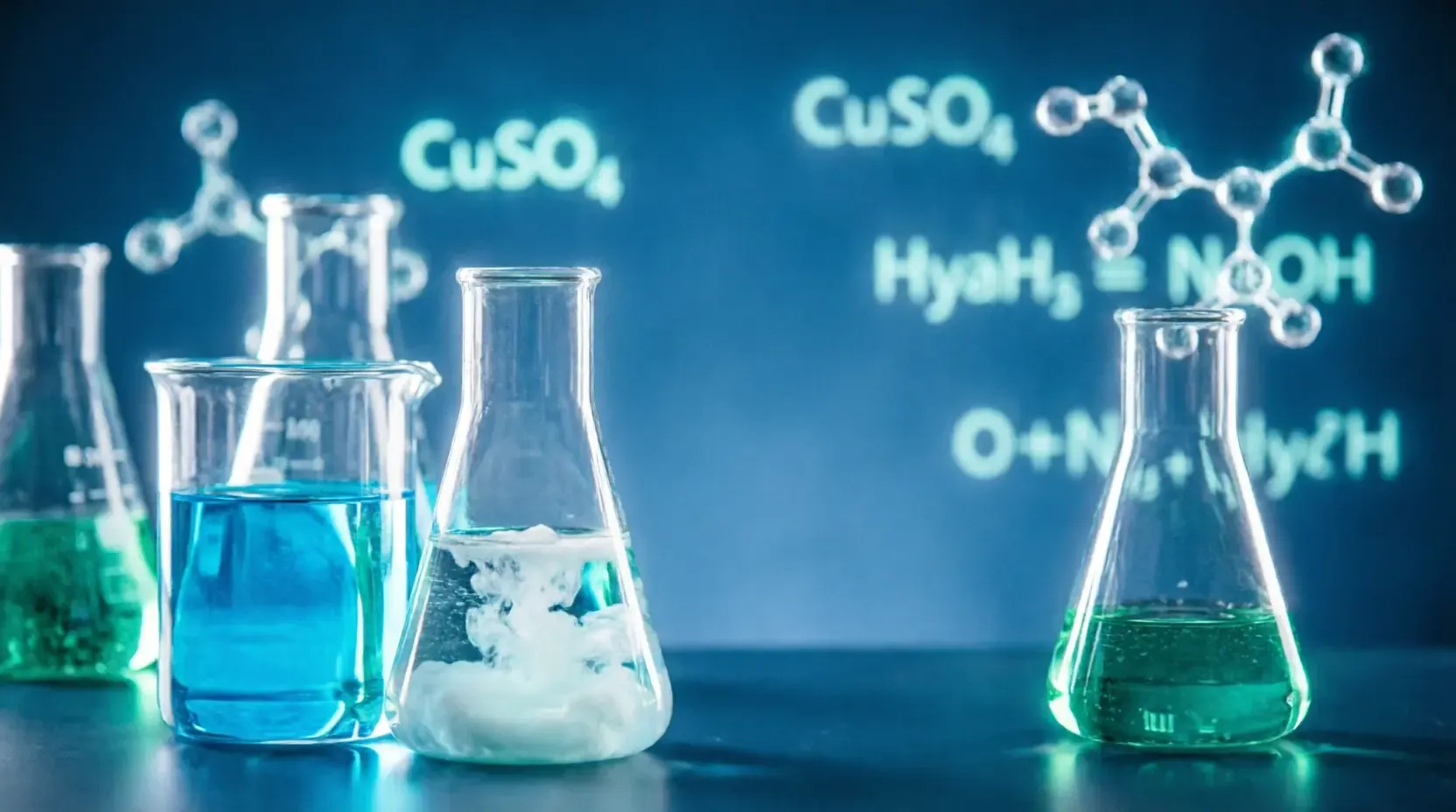
Quick definition: Chemical reactions convert reactants into new substances by rearranging atoms. Chemical equations use symbols and formulae to represent these changes. Balanced equations have equal numbers of each element's atoms on both sides, conserving mass. This chapter covers reaction types, oxidation, reduction, corrosion and rancidity.
Use this NCERT-aligned Class 10 Science guide to learn the definitions, balance equations, identify reactions and practise stepwise exam answers. Always confirm the chapter sequence and prescribed questions in the latest official NCERT textbook. The practice items below paraphrase familiar textbook concepts; the marking checklists are illustrative rather than official.
What is a chemical reaction?
A chemical reaction transforms reactants into products with different chemical properties. Atoms are rearranged and chemical bonds are broken or formed. In ordinary chemical reactions, atoms are conserved. Common clues include a gas being released, a precipitate appearing, a colour change, a temperature change or a change in state. None of these observations alone proves that a particular reaction occurred; interpret observations together with the reactants and products. Example: Burning magnesium in oxygen produces white magnesium oxide. The balanced equation is 2Mg(s) + O₂(g) → 2MgO(s). Magnesium ribbon should be cleaned before burning to remove its surface oxide coating. This reaction is a combination reaction and is exothermic. Observe such demonstrations only with proper school-laboratory supervision; burning magnesium is extremely bright and should not be viewed directly.
What is a chemical equation and what do its symbols mean?
A chemical equation uses formulae to show what reacts and what forms. The substances on the left of the arrow are reactants; those on the right are products. The plus sign separates substances, while the arrow means “yields”. State symbols are (s) for solid, (l) for liquid, (g) for gas and (aq) for an aqueous solution. For example, Zn(s) + H₂SO₄(aq) → ZnSO₄(aq) + H₂(g) represents zinc reacting with dilute sulphuric acid to form zinc sulphate and hydrogen gas. Reaction conditions such as heat (Δ), light or electricity can be indicated near the arrow. These conditions are not automatically reactants. An equation must use correct chemical formulae before balancing begins. Writing a word equation first can help: zinc + sulphuric acid → zinc sulphate + hydrogen.
Why must chemical equations be balanced?
The law of conservation of mass states that mass is neither created nor destroyed in an ordinary chemical reaction within a closed system. Because atoms are conserved, a correctly balanced equation contains equal numbers of each element's atoms on both sides. Consider H₂ + O₂ → H₂O: it is not balanced because there are two oxygen atoms on the left and one on the right. The balanced equation is 2H₂ + O₂ → 2H₂O. Now both sides have four hydrogen atoms and two oxygen atoms. Coefficients express relative numbers of molecules or formula units, and therefore relative amounts in moles. They do not directly represent grams. Never change the subscript in a formula: replacing H₂O with H₂O₂ changes the substance from water to hydrogen peroxide.
How do you balance chemical equations using the hit-and-trial method?
- Write the correct skeletal equation with the reactants and products.
- Count the atoms of each element on both sides.
- Adjust coefficients in front of formulae; begin with a compound containing several elements.
- Balance hydrogen and oxygen as convenient, then recount every element.
- Reduce to the smallest whole-number coefficients and add state symbols when known.
Fe + H₂O → Fe₃O₄ + H₂. There are three iron atoms in Fe₃O₄, so place 3 before Fe. Four oxygen atoms in Fe₃O₄ require 4H₂O. This supplies eight hydrogen atoms, so put 4 before H₂. Final equation: 3Fe(s) + 4H₂O(g) → Fe₃O₄(s) + 4H₂(g). Atom check: Fe 3=3, H 8=8, O 4=4. Second problem: aluminium oxide. Start Al + O₂ → Al₂O₃. Oxygen occurs in groups of two and three; the lowest common multiple is six. Use 3O₂ and 2Al₂O₃. Four aluminium atoms then appear on the right, so the balanced equation is 4Al + 3O₂ → 2Al₂O₃. Verify Al 4=4 and O 6=6. These examples illustrate a method rather than a universal order of balancing.
How can you verify a balanced equation using an atom-count table?
Krutsha AI recommends checking the atom counts rather than accepting a balanced equation solely because it looks familiar. Consider 4Al(s) + 3O₂(g) → 2Al₂O₃(s). The coefficients are 4, 3 and 2; the formula subscripts remain unchanged.
| Element | Reactant count | Product count | Check |
|---|---|---|---|
| Aluminium (Al) | 4 × 1 = 4 atoms | 2 × 2 = 4 atoms | Equal |
| Oxygen (O) | 3 × 2 = 6 atoms | 2 × 3 = 6 atoms | Equal |
Why this works: the balanced equation respects conservation of atoms. Its coefficients also express a 4:3:2 mole ratio for aluminium, oxygen and aluminium oxide; they do not state masses in grams. A mole is a unit of amount of substance, and converting moles to grams requires molar masses. This is an original teaching example; for prescribed textbook exercises consult NCERT.
How do you check iron reacting with steam?
For 3Fe(s) + 4H₂O(g) → Fe₃O₄(s) + 4H₂(g), verify Fe: 3 = 3, H: 8 = 8 and O: 4 = 4. The 3:4:1:4 coefficients give the stoichiometric ratio. The symbol (g) denotes gas and (s) denotes solid; neither is a numerical unit. Students should not change the H₂O or Fe₃O₄ subscripts to make the counts agree.
What are combination reactions?
A combination reaction forms a single product from two or more reactants. The general pattern is A + B → AB, but actual chemical formulae depend on the substances. A classic Class 10 example is slaking of lime: CaO(s) + H₂O(l) → Ca(OH)₂ + heat. Quicklime reacts with water to produce slaked lime and releases heat. Depending on the amount of water and conditions, the product may be present as a solid or an aqueous mixture; avoid assigning an inappropriate state without context. Another example is 2Mg + O₂ → 2MgO. A combination reaction may also be exothermic, but the two classifications answer different questions: combination describes the number of products; exothermic describes energy released.
What are decomposition reactions?
A decomposition reaction breaks one compound into two or more simpler products. Heat, light or electricity may supply the required energy. Thermal decomposition: CaCO₃(s) → CaO(s) + CO₂(g) on heating; this process is used in lime manufacture. Photochemical decomposition: 2AgCl(s) → 2Ag(s) + Cl₂(g) in sunlight. White silver chloride turns grey as metallic silver forms; this reaction helps explain the light sensitivity of some silver salts. Electrolytic decomposition: 2H₂O(l) → 2H₂(g) + O₂(g) when electricity is supplied under suitable experimental conditions. Hydrogen and oxygen form in a 2:1 volume ratio at comparable temperature and pressure. These are teacher-supervised demonstrations: electricity, gases and certain reagents pose safety hazards. In exam answers, distinguish the energy source from the product observation.
What is a displacement reaction?
In a displacement reaction, a more reactive element replaces a less reactive element from its compound. An iron nail placed in aqueous copper sulphate provides a familiar example: Fe(s) + CuSO₄(aq) → FeSO₄(aq) + Cu(s). The blue solution becomes pale green, and reddish-brown copper deposits on the iron. Iron is more reactive than copper, so it displaces copper from the solution. The reverse change does not occur merely by placing copper in iron(II) sulphate solution under ordinary classroom conditions. The reactivity series is useful for predicting these reactions. Avoid the common mistake of identifying every reaction with two reactants as displacement; the defining feature is replacement of one element by another.
What is double displacement and precipitation?
A double displacement reaction involves exchange of ions between compounds. When aqueous sodium sulphate and barium chloride are mixed, a white insoluble solid appears: Na₂SO₄(aq) + BaCl₂(aq) → BaSO₄(s) + 2NaCl(aq). Barium sulphate is the precipitate, making this a precipitation reaction as well. The equation is balanced: two Na, one S, four O, one Ba and two Cl atoms occur on both sides. Not every double displacement reaction produces a precipitate; some form water or a gas. For a full-mark exam-style response, name the reaction, write the balanced equation and state the observable white precipitate. Do not confuse this ion exchange with single displacement, in which one element replaces another.
What are oxidation and reduction in Class 10?
At the level of this chapter, oxidation can mean addition of oxygen or removal of hydrogen, while reduction can mean removal of oxygen or addition of hydrogen. These processes occur together in a redox reaction. Consider CuO(s) + H₂(g) → Cu(s) + H₂O(l) on heating. Black copper(II) oxide loses oxygen and is reduced to copper; hydrogen gains oxygen and is oxidised to water. The black material changes to reddish-brown copper. In later chemistry, oxidation and reduction are more generally explained as electron loss and gain, respectively. Therefore, oxygen-transfer definitions are useful introductory rules, not exhaustive definitions. Students should name both the oxidised and reduced substances and explain their reasoning.
How are exothermic and endothermic reactions different?
An exothermic reaction transfers energy to the surroundings, usually releasing heat. Respiration is exothermic overall: C₆H₁₂O₆ + 6O₂ → 6CO₂ + 6H₂O + energy. Combustion and the reaction between calcium oxide and water are further examples. An endothermic reaction absorbs energy from the surroundings. Some decomposition reactions require heat input; calcium carbonate decomposition is an example of a heat-driven process. However, an externally heated test tube does not by itself establish the thermodynamic category of a reaction. In answers, separate reaction classification by energy from classification by reactant-product pattern. A reaction can be both combination and exothermic, or decomposition and energy-requiring.
What are corrosion and rancidity?
Corrosion is the gradual chemical deterioration of a material, particularly a metal, due to its environment. Iron rusts in the presence of oxygen and moisture. Rust is commonly described as hydrated iron(III) oxide, Fe₂O₃·xH₂O, with variable hydration. Painting, oiling, galvanising and suitable alloying help prevent rust. Rancidity refers to undesirable smell and taste changes in foods containing fats or oils; oxidation is a common cause. Airtight storage, refrigeration, suitable antioxidants and nitrogen-flushed packaging can slow oxidative rancidity. Corrosion and rancidity both illustrate oxidation in daily life, but they affect different materials and should not be treated as identical processes. Give one cause and one prevention method for each in short-answer exams.
How do you solve NCERT-style textbook exercise questions?
The following questions are original paraphrases of common NCERT chapter concepts, not verbatim textbook reproduction. Mark allocations are illustrative study rubrics, not official CBSE marking schemes.
Question 1: Why is magnesium ribbon cleaned before burning?
Step 1: Identify the surface coating: magnesium oxide can form on stored ribbon. Step 2: Explain that cleaning exposes fresh magnesium, helping ignition. Step 3: Write 2Mg + O₂ → 2MgO. Illustrative 3-point checklist: oxide layer identified (1), reason for cleaning (1), balanced equation (1).
Question 2: Balance iron reacting with steam.
Start with Fe + H₂O → Fe₃O₄ + H₂. Balance Fe using 3Fe, oxygen using 4H₂O, and hydrogen using 4H₂. Answer: 3Fe + 4H₂O → Fe₃O₄ + 4H₂. Illustrative 3-point checklist: correct formulae (1), coefficients (1), atom verification (1).
Question 3: What happens when lead nitrate is heated?
On heating, lead(II) nitrate decomposes: 2Pb(NO₃)₂(s) → 2PbO(s) + 4NO₂(g) + O₂(g). Brown nitrogen dioxide fumes evolve. Illustrative 3-point checklist: decomposition identified (1), balanced equation (1), brown fumes (1). Safety: nitrogen dioxide and lead compounds are hazardous; never attempt this outside an authorised laboratory.
Question 4: Identify the reaction between sodium sulphate and barium chloride.
Na₂SO₄(aq) + BaCl₂(aq) → BaSO₄(s) + 2NaCl(aq). It is double displacement and precipitation, because insoluble white barium sulphate forms. Illustrative 3-point checklist: balanced equation (1), classification (1), observation (1).
Question 5: Explain oxidation and reduction using copper(II) oxide.
For CuO + H₂ → Cu + H₂O, CuO loses oxygen and is reduced; hydrogen gains oxygen and is oxidised. Illustrative 2-point checklist: correct reduction explanation (1) and oxidation explanation (1). Compare with the latest official CBSE marking scheme before assuming any real mark allocation.
What are common CBSE exam mistakes in this chapter?
The first trap is changing subscripts rather than coefficients: 2H₂O means two water molecules, whereas H₂O₂ is a different compound. The second is forgetting brackets: 2Ca(OH)₂ contains two calcium, four oxygen and four hydrogen atoms. The third is ignoring elemental molecules such as H₂, O₂, N₂ and Cl₂. The fourth is calling a precipitate reaction a displacement reaction without checking whether ions exchange partners. The fifth is mixing observation with explanation: “blue solution becomes pale green” is an observation; “iron displaces copper” explains it. Finally, students often omit conditions such as heating or sunlight, or label all energy-driven reactions as exothermic. Recheck atoms, formulae, observations, conditions and classifications separately.
How should you revise Chemical Reactions and Equations before exams?
Prepare a one-page table with columns for reaction type, balanced example, visible observation and required condition. Practise three to five unfamiliar balancing questions per session. After balancing, cover the answer and recount atoms from scratch. Create flashcards for precipitate, oxidation, reduction, corrosion and rancidity, but also explain each term aloud using an example. Alternate between identifying reactions and writing equations so that recognition does not replace understanding. Track errors as incorrect formula, incorrect coefficient, wrong reaction type, missing observation or missing condition. Retry mistakes the next day and again later in the week. For board-style practice, use the current NCERT textbook and the CBSE Academic sample question papers and marking schemes. AI study tools may help explain steps, but verify unusual claims against the textbook and solve independently.
Frequently asked questions
What is a balanced chemical equation?
A balanced chemical equation has the same number of atoms of each element on the reactant and product sides. Adjust coefficients, not subscripts, to balance it.
How can I balance chemical equations quickly in Class 10?
Write correct formulae, count atoms, adjust whole-number coefficients, then recount every element. For example, 4Al + 3O₂ → 2Al₂O₃.
What are the five main reaction types in Class 10?
Common categories include combination, decomposition, displacement, double displacement and oxidation-reduction reactions. Precipitation is often discussed with double displacement.
What is the difference between oxidation and reduction?
In the chapter's oxygen-transfer examples, oxidation involves gaining oxygen while reduction involves losing oxygen. In CuO + H₂ → Cu + H₂O, CuO is reduced and hydrogen is oxidised.
Are the marking schemes in this guide official CBSE schemes?
No. The point-by-point checklists are illustrative teaching aids. Use the official CBSE marking scheme for the relevant examination to determine actual marks.
Primary sources and further reading
NCERT official textbooks: select the current Class 10 Science textbook and its Chemical Reactions and Equations chapter. CBSE Academic: consult the applicable Class X Science curriculum, sample papers and marking schemes for your examination year. CBSE 2025–26 curriculum archive and CBSE 2025–26 Class X sample papers are historical references; do not assume these are the current-year documents.
Final checklist: Write correct formulae, balance without changing subscripts, identify reaction types, explain observations, distinguish oxidation from reduction, and use official marking schemes for assessed work.
Source attribution: The scientific definitions and prescribed chapter concepts should be checked against the official NCERT Class 10 Science textbook and the applicable CBSE Academic curriculum. The atom-count table and revision workflow are original explanations prepared by Krutsha AI; they are not claims of a published educational experiment or official CBSE marking rubric.
Glossary & key definitions
Chemical reactions convert reactants into new substances through rearrangement of atoms. Chemical equations represent these changes with symbols and formulae. A balanced equation has equal numbers of each element’s atoms on both sides. Class 10 also covers reaction types, oxidation, reduction, corrosion and rancidity.
Sources & further reading
NCERT official textbooks — Class 10 Science, Chemical Reactions and Equations (primary textbook source; select current edition): https://ncert.nic.in/textbook.php
CBSE Academic — official Class X Science curriculum, subject guidelines and current-year examination resources (primary board source): https://cbseacademic.nic.in/
CBSE Academic 2025–26 curriculum archive (historical, not assumed current): https://cbseacademic.nic.in/curriculum_2026.html
CBSE Academic 2025–26 Class X sample question papers and marking schemes (historical assessment examples): https://cbseacademic.nic.in/SQP_CLASSX_2025-26.html
Krutsha AI — publisher and original pedagogy/atom-count explanation (not an independent scientific source): https://krutsha.app/
Editorial note: NCERT-style exercises are paraphrased; illustrative marking checklists are not official CBSE mark allocations.
No perspectives submitted yet. Be the first to start the discussion.