
Key takeaways
- Chapter mastery: Understand, recall and apply concepts without open notes; rereading alone is not proof of exam readiness.
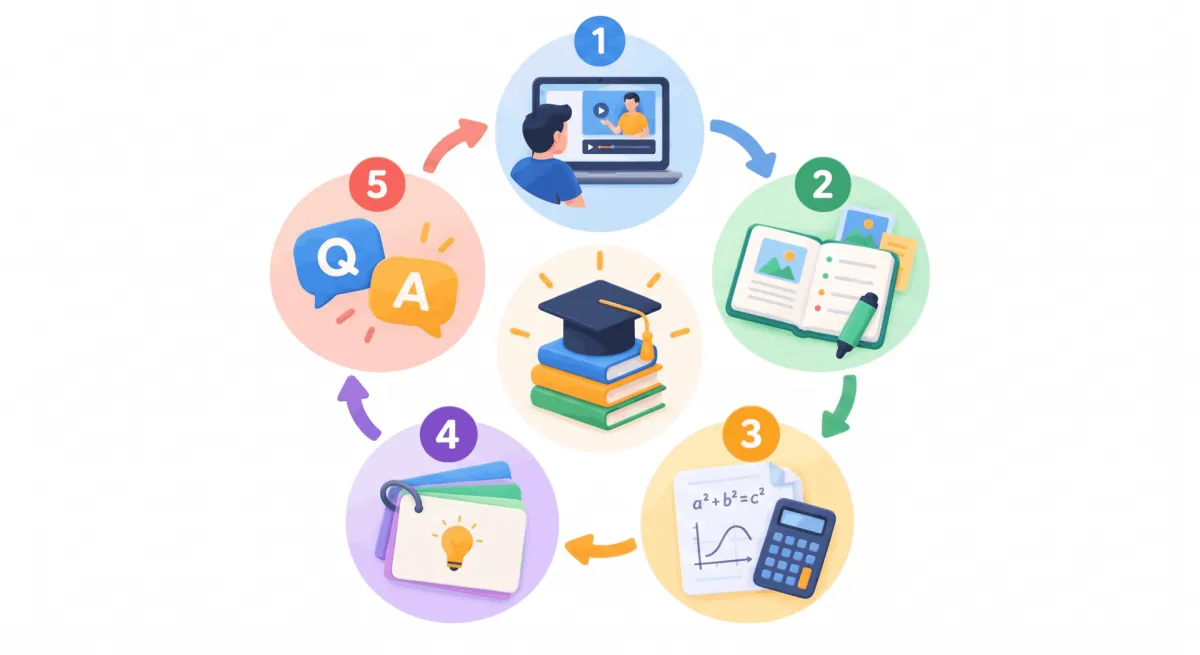
- Five-step workflow: Study diagrams, test yourself with flashcards, answer analogy-based questions, practise worked examples, then use short videos for remaining gaps.
- Formula and unit traps: For numericals, state the formula, define variables, substitute with correct SI units, check signs and calculations, and verify the final answer.
- CBSE application practice: Attempt case-based and unfamiliar questions, not only memorised definitions; consult the current official syllabus and marking schemes.
- Retrieval and revision: Answer before revealing flashcards, track mistakes, redo questions independently and space out subsequent practice.
A Class 10 student reads the chapter on Light twice, highlights half the page, and still stalls on a case-based question. Familiarity feels like knowledge, but exams test recall and application. That gap matters more now: reports on the 2026 pattern say about half of CBSE Class 10 and 12 papers are competency-based, which means case studies, data interpretation and real-life scenarios.
Krutsha AI's 5-step method turns ordinary notes for exam preparation into something you can recall and apply. Here is what each step does, and the learning research behind it.
What does chapter mastery mean for NCERT and CBSE exams?
Chapter mastery means you can explain a chapter's ideas, recall them without the textbook, and apply them to a question you have not seen before. Good notes for exam preparation are only the first piece. A sequence of different study modes gets you the rest of the way.
How do you master an NCERT chapter in five steps?
How do diagram notes improve NCERT chapter revision?
Richard Mayer's research, learners who received words plus pictures did better on transfer tests than those given words alone. Mayer also notes the effect may be stronger for newcomers to a topic, which describes most students opening a fresh chapter.
How should students use audio flashcards for active recall?
Flashcards or skimcards turn a passive page into a question you must answer. Audio in Hindi and English lets you revise on a bus ride, eyes off the screen. Mayer's modality principle points the same way: spoken narration paired with graphics tends to beat printed text paired with graphics.
How do analogy-based questions prepare students for CBSE application questions?
Questions are labelled easy, moderate or hard. Each answer pairs a direct, exam-ready version with an analogy and a memory trick. Competency-style questions reward understanding over memorised lines, and an analogy gives you something to reason from when the wording changes.
If an intermediate derivation step still leaves you stuck, you can use 24x7 AI doubt solving to unpack tricky questions line by line.
How should students revise formulas, units and worked examples?
A bare list of math formulas hides the thinking. Krutsha's formula section gives the formula, its meaning, a real-life scenario, what each variable stands for, and a solved problem ending in the final answer and unit. A common-mistakes note sits alongside. Read it before you practise, because units and sign errors are easy marks to drop.
Students can also cross-reference curated formula sheets in our free study resources vault.
When do short concept videos help with difficult chapters?
Some topics need to be seen. Each chapter has short videos, and watching in small pieces suits another Mayer finding: learners do better when a lesson arrives in learner-paced segments rather than one long stream.
Why is active recall better than repeatedly reading notes?
In a well-known 2006 study by Roediger and Karpicke, researchers compared repeated testing with repeated study. One week later, the testing group recalled about 61% against about 40%. The study used college students and short prose passages, not CBSE chapters, so read it as a principle, not a promise of marks.
That is why Skimcards, quizzes and a Revise section that brings back missed questions push you to retrieve answers instead of rereading them.
How much does Krutsha's chapter revision cost?
The Free Starter plan includes chapter notes with diagrams, audio flashcards and analogy skimcards. Krutsha Pro is listed at ₹349 a month on the pricing page and adds AskAI photo doubts, quizzes and exam simulations.
Frequently asked questions
Which study apps offer structured chapter mastery for CBSE?
Krutsha organises each Class 8 to 12 NCERT and CBSE chapter into diagram notes, audio flashcards, Q&A with analogies, formulas with worked examples and short videos. When comparing any apps, check whether one chapter offers all these modes or only one.
What is 5-step chapter mastery for NCERT?
It is a study sequence for one chapter: diagram notes, audio flashcards, analogy-based Q&A, formulas with step-by-step examples, then short concept videos.
Do audio flashcards help with exam preparation?
They help when you answer before the reveal. Listening alone is passive; the benefit comes from retrieving the answer yourself.
Is the material aligned to the curriculum?
Krutsha states its content is aligned with NCERT and CBSE for Classes 8 to 12. ICSE and state boards are listed as coming soon. Check chapters against your school's current syllabus.
How can I avoid losing marks in CBSE numerical questions?
Write the relevant formula, show substitutions with appropriate units, check signs and arithmetic, and present a clear final answer. Actual marks depend on the question-specific official marking scheme.
How can students check whether they have mastered a chapter?
Rote learning breaks the moment a question changes shape. The five steps give you one concept in five forms: seen, heard, explained, calculated and watched. Pick the chapter you dread most, run it through all five, then test yourself with the notes closed.
Sources and References
|
Source |
Publisher |
Supports |
URL |
|
CBSE Announces Major Board Exam Pattern Change in 2026 |
Adda247 |
50% competency-based questions from 2026 |
https://www.adda247.com/school/cbse-announces-major-board-exam-pattern-change-in-2026/ |
|
CBSE Result 2025: competency-based questions "yielded results" |
Careers360 |
Board's statement on competency-based questions |
|
|
Multimedia Principle (Multimedia Learning, ch. 12) |
Mayer, Cambridge University Press |
Words plus pictures; newcomer boundary condition |
|
|
Mayer's 12 Principles of Multimedia Instruction |
NUS Medicine |
Modality and segmenting principles |
|
|
Testing effect |
Encyclopedia.pub |
61% vs 40% finding |
|
|
Test-Enhanced Learning (Roediger and Karpicke, 2006) |
Psychological Science |
Original study |
https://psychology.ecu.edu/wp-content/pv-uploads/sites/216/2019/03/Roediger-Karpicke-2006.pdf |
|
Krutsha AI home page |
Krutsha AI |
Features, alignment claim |
|
|
Pricing Plans |
Krutsha AI |
Plans and ₹349/month |
Glossary & key definitions
NCERT chapter mastery means understanding, recalling and applying a chapter without relying on open notes. A practical five-step revision method uses diagram notes, active-recall flashcards, analogy-based questions, worked examples and short videos. Students should then attempt unseen CBSE-style questions and revisit mistakes to check understanding.
Sources & further reading
CBSE Announces Major Board Exam Pattern Change in 2026 (Adda247).
- Supports: 50% competency-based question allocation across Class 10 and 12 board examination papers.
- Link: https://www.adda247.com/school/cbse-announces-major-board-exam-pattern-change-in-2026/
CBSE Result 2025: Competency-Based Questions 'Yielded Results' (Careers360).
- Supports: Official board statements and analysis regarding competency question implementation and student outcomes.
- Link: https://news.careers360.com/cbse-result-2025-board-class-10-12-competency-based-questions-yielded-results-pass-rate-improves-toppers-merit-list
Multimedia Principle (Multimedia Learning, Ch. 12, Richard E. Mayer, Cambridge University Press).
- Supports: Learning advantages of integrated words plus pictures over words alone, particularly for topic newcomers.
- Link: https://www.cambridge.org/core/books/abs/multimedia-learning/multimedia-principle/1CC3DE892B0431BA48B4C4DCA10D0B8F
Mayer's 12 Principles of Multimedia Instruction (NUS Medicine).
- Supports: Modality principle (spoken audio paired with visuals) and segmenting principle (chunked learner-paced lessons).
- Link: https://medicine.nus.edu.sg/medixperience/scholarly-article/mayers-12-principles-of-multimedia-instruction/
Test-Enhanced Learning: Taking Memory Tests Improves Long-Term Retention (Psychological Science, Roediger & Karpicke, 2006).
- Supports: The testing effect showing self-testing achieves ~61% long-term retention compared to ~40% for repeated reading.
- Link: https://psychology.ecu.edu/wp-content/pv-uploads/sites/216/2019/03/Roediger-Karpicke-2006.pdf
Krutsha AI Official Platform (Krutsha AI, SSKART).
- Supports: 5-step chapter mastery workflow, diagram notes, audio skimcards, formula practice, AskAI photo doubt solving, and Free Starter vs. Pro pricing tier.
- Link: https://krutsha.app/
No perspectives submitted yet. Be the first to start the discussion.