
Key takeaways
- Habits Outperform Early Syllabi: Early preparation in Class 8 focuses on cementing daily study rhythms and conceptual understanding rather than prematurely rushing through Class 10 textbooks.
- Two-Board Exam System: Starting from 2026, CBSE conducts two Class 10 board exam phases (Phase 1 compulsory, Phase 2 optional for improvement), rewarding consistent cumulative study over emergency cramming.
- 50% Competency Exam Structure: Modern CBSE papers allocate half of total theory marks to case-based, source-based, and practical application questions, rendering rote memorization obsolete.
- Subject-Specific Mastery Strategies: Emphasize re-solving math problems independently after one week, reproducing labeled science diagrams from memory, and writing cause-and-effect timelines for social science.
- Systematic 3-Tier Revision Routine: Consolidate long-term retention by revising new chapters the next day, after one week, and after one month, logging every mistake into a dedicated errors notebook.
TL;DR: Early board exam preparation in Class 8 means building habits, not finishing the Class 10 syllabus. Read NCERT properly, revise every week, practise application questions and keep a steady daily routine. Class 10 now has two board exams and about 50% competency-based questions, so understanding matters more than memorising.
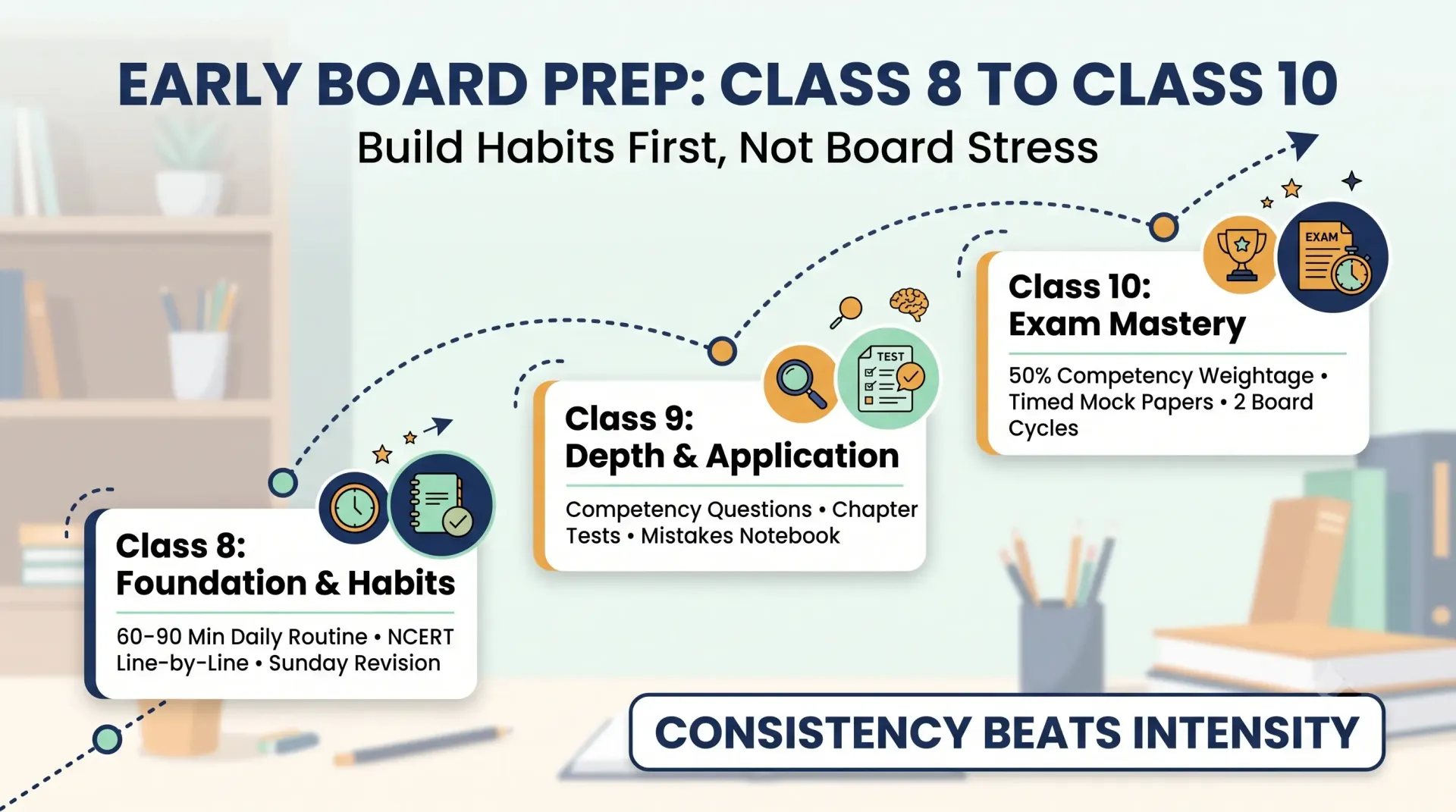
Class 8 students do not need board exam stress. They need a head start on how they study. Early board exam preparation works best when it is quiet and regular: a daily reading habit, clear concepts and one weekly revision slot. A student in Class 8 today reaches Class 10 in 2028-29, and by then these habits will count for more than any crash course.
Why Class 8 Preparation for Class 10 Matters Now
The exam itself has changed. CBSE began holding two Class 10 board exams from 2026: the first is compulsory, the second is optional, and the better score counts. The Class 10 pattern also gives 50% weightage to competency-based questions such as case studies and source-based items. About 26.6 lakh Class 10 students were expected to appear in 2026.
Rules can shift, so check the CBSE website before each session.
|
Stage |
Main goal |
Weekly rhythm |
|
Class 8 |
Concept clarity and habits |
Daily NCERT reading, one revision session |
|
Class 9 |
Depth and application |
Chapter tests, a mistakes notebook |
|
Class 10 |
Full-syllabus revision |
Timed papers, two revision rounds |
Build a Study Routine for Students
Consistency beats intensity. These CBSE study habits are realistic for a 13-year-old:
• Study at the same time daily, for 60 to 90 minutes with short breaks (a practical starting point, not a rule).
• After each chapter, write a five-line summary in your own words.
• Keep one weekly slot, such as Sunday morning, only for revision.
• Keep the phone in another room while studying.
Get NCERT Concepts Clear First
Most board questions come from NCERT or are built on its concepts, though not every question is a direct copy. So read the chapter slowly, then attempt every exercise. If you cannot explain an idea aloud to a family member, you have not understood it yet.
By subject:
• Mathematics: Solve, then re-solve the hard sums a week later without looking.
• Science: Draw diagrams from memory and explain each label.
• Social Science: Make timelines and short cause-and-effect notes.
• English and Hindi: Read daily and write a few lines about what you read.
Revision Routine for Class 10 Preparation from Class 8
Revise a chapter the next day, after a week and after a month. Each pass takes less time than the last.
Add practice questions that ask "why" and "how", since these resemble competency-based items. Five a chapter is enough. Record every wrong answer in a mistakes notebook with the correct reasoning, and revisit that notebook before tests.
Time Management in Early Board Exam Preparation
Plan the week on Sunday and list three tasks per day. Protect sleep and playtime, because tired students retain less. Small wins build confidence: finish one chapter well, then the next. Parents can help most by asking what was learned today instead of how many hours were spent.
Where a Study App Can Help
Apps cannot replace effort, but they can reduce friction. Krutsha covers NCERT and CBSE content for Classes 8 to 12, with diagram notes, skimcards, quizzes and photo-based doubt solving (see its Class 10 Science and Mathematics pages for a preview). Its pricing starts with a free plan; Krutsha Pro is listed at ₹349 a month with 500 photo doubts and daily WhatsApp reports for parents, plus a 7-day free trial. You can install it from Google Play.
FAQs
When should students start preparing for Class 10 boards?
Class 8 is a good time to build habits, such as daily reading and weekly revision. Intensive board practice can wait until Class 10.
How many hours should a Class 8 student study?
There is no official figure. Many families begin with 60 to 90 focused minutes and adjust to the child's school load.
Is NCERT enough for CBSE board preparation?
It is the foundation, but add application and case-based practice because of the competency-based weightage.
Does early board exam preparation mean more pressure?
Not if it stays small and regular. Short daily sessions are less stressful than months of last-minute cramming.
Can a study app help with early board exam preparation?
It can support the routine but not replace effort. Krutsha offers NCERT-aligned notes, quizzes and photo doubt solving for Classes 8 to 12, plus daily WhatsApp reports for parents.
Conclusion
Early board exam preparation is mostly about routine: understand NCERT, revise on schedule, practise application questions and keep the pace comfortable. Start with one chapter this week and one revision slot on Sunday.
Sources and References
|
Source |
Publisher / date |
URL |
Supports |
|
Tribune India, "CBSE Class X board exams twice a year from 2026" |
Tribune India (date not shown on page) |
https://www.tribuneindia.com/news/india/cbse-class-x-board-exams-twice-a-year-from-2026 |
First exam mandatory, second optional, better score counted |
|
CBSE Class 10 Exam Pattern 2026 |
Physics Wallah (updated 2026) |
https://www.pw.live/exams/school/cbse-class-10-exam-pattern-2025 |
50% weightage for competency-based questions |
|
CBSE plans two board exams for Class X from 2026 |
Gulf News (2025) |
About 26.6 lakh Class 10 students expected in 2026 |
|
|
Are all CBSE board exam questions from NCERT? |
Careers360 (date not shown) |
https://www.careers360.com/question-cbse-board-exam-all-question-are-ncert-book/amp |
Most questions based on NCERT; not all direct copies |
|
CBSE official website (scheme for two Class X exams, circulars) |
Central Board of Secondary Education |
Check current rules before each session |
|
|
Krutsha features |
Krutsha AI (SSKART), accessed Oct 2026 |
Notes, skimcards, quizzes, photo doubts, parent reports |
|
|
Krutsha pricing |
Krutsha AI (SSKART), accessed Oct 2026 |
Free plan; Pro Rs 349/month |
Glossary & key definitions
Early Board Exam Preparation is the proactive academic practice of establishing consistent daily study habits, NCERT conceptual clarity, active recall methods, and mistake-analysis routines during Class 8 and 9 to prepare smoothly for CBSE Class 10 two-phase board examinations and 50% competency-based question formats without late-stage academic stress.
Sources & further reading
CBSE Class X Board Exams Twice a Year from 2026 (Tribune India).
- Supports: Phased exam format with mandatory first exam, optional second exam, and retention of the best score.
- Link: https://www.tribuneindia.com/news/india/cbse-class-x-board-exams-twice-a-year-from-2026
CBSE Class 10 Exam Pattern 2026 (Physics Wallah).
- Supports: 50% weightage allocated to competency-focused, application, and case-based questions.
- Link: https://www.pw.live/exams/school/cbse-class-10-exam-pattern-2025
CBSE Plans Two Board Exams for Class X from 2026 (Gulf News, 2025).
- Supports: Demographic scale with approximately 26.6 lakh Class 10 candidates appearing in board cycles.
- Link: https://gulfnews.com/world/asia/india/cbse-plans-to-hold-two-board-exams-for-class-x-from-2026-seeks-public-feedback-1.500046383
Are All CBSE Board Exam Questions from NCERT? (Careers360).
- Supports: Majority of board questions rooted in NCERT conceptual frameworks rather than verbatim textbook lines.
- Link: https://www.careers360.com/question-cbse-board-exam-all-question-are-ncert-book/amp
CBSE Official Academic Portal (Central Board of Secondary Education).
- Supports: Official date sheets, secondary curriculum blueprints, and board evaluation schemes.
- Link: https://www.cbse.gov.in/
Krutsha AI Official Platform (Krutsha AI, SSKART, Oct 2026).
- Supports: Multi-grade Class 8–12 NCERT curriculum, AskAI photo doubt solving, 4-step chapter hub, Free Starter plan, and Krutsha Pro tier.
- Link: https://krutsha.app/
No perspectives submitted yet. Be the first to start the discussion.