
Key takeaways
- Why Practical Files Matter (30 Marks): In Class 12 Physics, Chemistry, and Biology, practicals make up 30% of your total board score. A clean, complete file secures easy marks before you ever touch a burette or sit for viva.
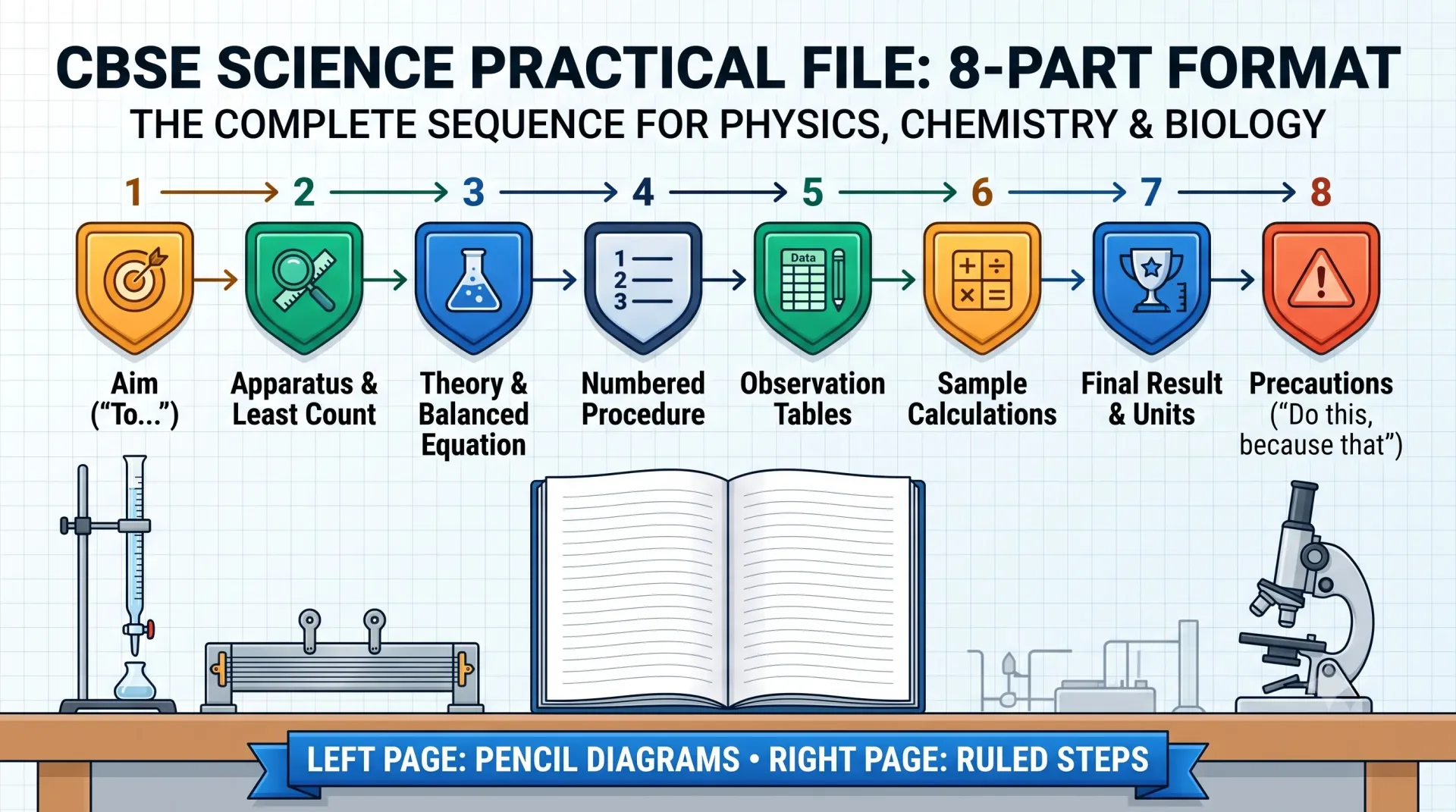
- The 8-Part Experiment Sequence: Every experiment follows one strict order: Aim, Apparatus, Theory, Procedure, Observations, Calculations, Result, and Precautions (plus sources of error in Physics).
- CBSE Lab Manual Rules: Open the aim with "To", write numbered procedures as clear instructions, keep pencil diagrams on the left page, and always list instrument least count and units above observation tables.
- "Do This, Because That" Precautions: Write four to six precautions explaining the exact science behind them. This gives you solid marks and doubles as instant prep for tricky viva questions.
- Never Copy Lab Readings: External examiners check your file against how you work in the lab. Fake numbers stand out immediately and cost you marks in the viva.
|
TL;DR
|
Your practical file earns marks before you ever touch a burette. In the 2026-27 CBSE scheme, Class 12 Physics, Chemistry and Biology each carry 30 practical marks out of 100, and the file is one slice of that. A neat CBSE science practical file with a sharp aim, a clean procedure and precautions that mean something also makes your viva easier. Here's how to write each part, with physics, chemistry and biology examples.
How many marks is a CBSE science practical file worth?
In the 2026-27 CBSE scheme, Class 12 Physics, Chemistry and Biology give 30% of the marks (30 out of 100) to practicals and 70% to a theory paper [1][5]. The practical file is one component, sitting beside the experiment you perform, the viva and the project. These are the numbers worth knowing:
|
Metric |
Figure |
Source |
|
Practical marks, Class 12 Physics, Chemistry, Biology |
30 out of 100 (30%) |
|
|
Theory marks, same subjects |
70 out of 100 (70%), 3-hour paper |
|
|
Physics practical record |
5 marks, about one-sixth of the 30 |
|
|
Minimum Physics experiments in the record |
8 (4 from each section) |
|
|
Minimum Physics activities in the record |
6 (3 from each section) |
|
|
Class 10 internal assessment |
20 marks, including 5 for subject enrichment (practical work) |
|
|
2026 practical exam window |
1 January to 14/15 February |
A 5-mark record looks small until you remember it's one-sixth of your practical marks, and the same CBSE science practical file feeds your viva. The split for Chemistry and Biology differs, so check your subject's syllabus PDF on CBSE's academic website.
For Class 12, the board also appoints an external examiner at each school [3]. A stranger will flip through your file, so make it easy for them. And watch the calendar: the 2026 practical window ran from 1 January to 14/15 February [7]. If 2027 follows a similar pattern, aim to finish your file by December.
What are the 8 parts of a CBSE science practical file page?
Every experiment page has 8 parts, always in this order: aim, apparatus or materials, theory, procedure, observations, calculations, result and precautions. Most lab manuals for Class 12 follow this order, and your CBSE science practical file should too.
|
Section |
What to write |
Subject-specific watch-out |
|
Aim |
One sentence starting with "To" |
Match the syllabus wording |
|
Apparatus / Materials |
A simple list of everything used |
Physics: add range and least count of each instrument |
|
Theory / Principle |
The law, formula or reaction behind it |
Chemistry: include the balanced equation |
|
Procedure |
Numbered steps in the order you did them |
Physics: draw the circuit or ray diagram first |
|
Observations |
A table with units and several trials |
Biology: draw in pencil and label clearly |
|
Calculations |
Formula, substitution, answer with unit |
Never leave out the unit |
|
Result |
One line stating your final value or finding |
Quote it to the right number of digits |
|
Precautions |
Four to six specific points |
Physics: add sources of error |
In many schools, a CBSE science practical file keeps diagrams on the blank left page and writing on the ruled right page. Ask your teacher once, then stick to it.
How do you write the aim in your CBSE science practical file?
Write the aim as one sentence that starts with "To" and a verb like find, determine, prepare or study. Copy the syllabus wording instead of inventing your own.
Physics practical file example
Aim: To find the resistance of a given wire using a metre bridge and hence determine the resistivity of its material.
It names the instrument and the final quantity, so the examiner knows what's coming before reading a line.
Chemistry practical format example
Aim: To determine the molarity of a KMnO4 solution by titrating it against a standard solution of oxalic acid.
Chemistry aims name both solutions and the thing you're finding. That's the whole job. Rusty on balanced equations for your theory section? Krutsha's Class 10 chemical reactions notes cover balancing [13].
Biology practical file example
Aim: To prepare a temporary mount to observe pollen germination.
Short wins here. Your labelled diagram does the heavy lifting later. And never tuck the result into the aim.
How do you write a procedure examiners can follow?
Number each step, put one action in each, and write them in the order you actually did them. Pick one tense and don't switch. Six to ten steps is a good range. Here's the KMnO4 titration, trimmed:
1. Rinse the burette with KMnO4 solution, fill it, remove air bubbles from the nozzle and note the initial reading.
2. Pipette the oxalic acid solution into a clean conical flask.
3. Add dilute sulphuric acid and warm the mixture to about 60–70°C.
4. Add KMnO4 from the burette drop by drop, swirling constantly.
5. Stop at the first permanent light pink colour. KMnO4 is its own indicator, so you don't need another.
6. Note the final reading and repeat until you get three concordant readings.
Physics procedures start with a labelled circuit or ray diagram. Biology procedures lean on the diagram you draw afterwards. In every subject, avoid "I did". Write the steps as instructions.
How do you write observations and calculations examiners can check?
Put every reading in a table with units in the column headings, then show one full sample calculation and list the rest in a results column. An examiner should be able to repeat your arithmetic in under a minute.
Write the least count of each instrument above the table, and take at least three readings. One reading can't show whether you were consistent.
Take the metre bridge. With a known resistance S and a balance length l, the unknown resistance is R = S × l / (100 − l). Say S is 10 Ω and the balance point is at 40 cm. Then R = 10 × 40 / 60 = 6.67 Ω. These numbers are only an illustration, so use your own readings. Resistivity then follows from ρ = Rπd²/4L, where d is the wire's diameter and L is its length.
End with the unit and a sensible number of digits. A final answer of 6.6666667 Ω shows you copied the calculator, not that you measured with a metre scale.
How do you write the result and sources of error?
State the result in one line with its value, unit and conditions, like "The resistance of the given wire is 6.7 Ω at room temperature." Then list the sources of error, which are the honest reasons your value might be slightly off.
• Physics: contact resistance at loose joints, end errors in the bridge wire, and the wire heating up.
• Chemistry: overshooting the end point by a drop, or reading the burette from the wrong eye level.
• Biology: a contaminated slide, or pollen that wasn't fresh.
Skip "human error". Name the specific thing that could have gone wrong, because that's what shows you understood the experiment.
How do you write precautions that earn marks?
Write precautions that are specific to the experiment and say why they matter. A line like "handle apparatus carefully" tells the examiner you didn't think about the experiment. Aim for four to six per experiment page of your CBSE science practical file.
|
Experiment |
Weak line |
Stronger line |
|
Metre bridge |
Handle the apparatus carefully. |
Insert the key only while taking a reading, so the wire doesn't heat up and change its resistance. |
|
KMnO4 titration |
Use clean apparatus. |
Use dilute sulphuric acid, never HCl, because HCl is oxidised by KMnO4 and gives a wrong reading. |
|
Pollen germination |
Be careful with the slide. |
Lower the cover slip slowly from one edge to avoid air bubbles, and keep the slide in a moist place so the medium doesn't dry out. |
Write every precaution as "do this, because that". It doubles as viva prep. "Why dilute sulphuric acid and not HCl?" is exactly the kind of question a viva can throw at you. For this titration, also read the upper meniscus, since the dark solution hides the lower one.
Which mistakes cost marks in a CBSE science practical file?
• Copying observations from a friend or a manual. Identical readings across files stand out fast, and the viva exposes the rest.
• Missing units, least count or range. A reading without a unit is half a reading.
• Messy diagrams. Draw in pencil, label with straight lines, and give every figure a caption.
• Gaps in the record. Physics expects at least 8 experiments and 6 activities [4], so a missing page is a risk.
• No teacher signatures or dates. Get them as you go, not the night before submission.
How do you prepare for the practical viva using your file?
Treat every line of your CBSE science practical file as a possible question. If you can't explain why a step or precaution is there, rewrite it until you can. Here are five to practise:
• Physics: Why is the balance point best near the middle of the wire? The percentage error in the result is smallest there.
• Physics: Why insert the key only while taking readings? Continuous current heats the wire and changes its resistance.
• Chemistry: Why warm the oxalic acid solution before titrating? The reaction is slow at the start in the cold.
• Chemistry: Why doesn't KMnO4 need an indicator? Its own pink colour marks the end point.
• Biology: Why add sucrose solution to the slide? It supplies nutrients and the right osmotic balance for the pollen tube to grow.
Say each answer aloud once. It takes a minute and sticks better than rereading.
How can Krutsha AI help with your CBSE science practical file?
Krutsha AI won't write your CBSE science practical file, and you wouldn't want it to, because a copied file collapses in the viva. It can help you understand what you're writing. The Formulas section gives each key formula with a summary of every variable, a worked example and the final unit, which is what your calculations section needs [9]. Our NCERT numerical solutions guide shows how to use step-by-step answers without just copying them [11]. Unsure why a precaution matters? Ask AskAI by typing the question or uploading a photo of your page, and see how the late-night doubt solver works [12]. Chapter notes for your syllabus sit in the Class 12 NCERT hub [14].
Frequently asked questions
What is the format of a CBSE science practical file?
Aim, apparatus, theory, procedure, observations, calculations, result and precautions, in that order. Physics adds sources of error; biology adds labelled diagrams.
How many experiments does the CBSE Class 12 Physics practical file need?
The 2026-27 Physics syllabus asks for at least 8 experiments and 6 activities, split equally between sections. Confirm in CBSE's official PDF.
How many marks is the science practical worth in CBSE Class 12?
Class 12 Physics, Chemistry and Biology carry 30 practical marks (30%) and 70 theory marks. A CBSE science practical file is one part of those 30.
How many precautions should I write for each experiment?
Four to six specific ones, each saying what to do and why. Physics files often add sources of error too.
Can I copy from a lab manual for Class 12 practical files?
Use it for aim and procedure wording, but write observations and results from your own readings. The viva tests that.
Ready to fix your CBSE science practical file tonight?
Pick the experiment page you like least. Rewrite the aim as one line, turn each precaution into a "do this, because that" sentence, and check your calculation against a formula you trust. Then move to the next page. If a step doesn't make sense, ask AskAI why. More guides are on the Krutsha AI blog [15].
Get Krutsha AI on Google Play →
Sources and References
|
# |
Source |
Type |
Used for |
Full URL |
|
CBSE Academic Unit (Senior Secondary Curriculum, Class XI–XII) |
Official |
Syllabus, marks scheme and experiment lists. Verify all figures here. |
||
|
Careers360: CBSE Class 12 Physics practical 2026 |
Education site |
30-mark practical and evaluation scheme |
https://school.careers360.com/boards/cbse/cbse-class-12-practical-exams-2026 |
|
|
Careers360: CBSE practical exam dates |
Education site |
External examiner appointed for Class 12 practicals |
https://school.careers360.com/boards/cbse/cbse-practical-exam-guidelines-2026-class-10-12 |
|
|
Syllabus4u: CBSE Class 12 Physics syllabus |
Education site |
At least 8 experiments and 6 activities; 5-mark record |
||
|
FindMyCollege: Class 12 Physics sample paper 2026-27 |
News site |
70 theory (3-hour paper) plus 30 practical for science subjects |
||
|
Motion: CBSE Class 12 chapter-wise weightage 2026-27 |
Education site |
70 + 30 split and 5-mark Physics notebook |
https://motion.ac.in/examinfo/cbse-class-12-chapter-wise-weightage/ |
|
|
Physics Wallah: CBSE practical exam date sheet 2026 |
Education site |
2026 practical window; Class 10 internal assessment of 20 marks |
https://school.careers360.com/boards/cbse/cbse-class-12-date-sheet-2026 |
|
|
Careers360: CBSE Class 10 Science syllabus 2026-27 |
Education site |
5 marks for subject enrichment (practical work) |
https://school.careers360.com/boards/cbse/cbse-class-10-science-syllabus |
|
|
Krutsha AI website |
Krutsha AI |
Formulas section, AskAI and plans |
||
|
Krutsha AI on Google Play |
Krutsha AI |
App download for Class 8–12 |
https://play.google.com/store/apps/details?id=com.sskart.krutsha |
|
|
Krutsha blog: NCERT numerical solutions, step-by-step photo guide |
Krutsha AI |
Using step-by-step answers without copying |
https://krutsha.app/blog/ncert-numerical-solutions-step-by-step-photo-guide |
|
|
Krutsha blog: 24x7 AI doubt solver for CBSE students |
Krutsha AI |
How the late-night doubt solver works |
https://krutsha.app/blog/ai-doubt-solver-cbse-late-night-study |
|
|
Krutsha blog: Class 10 chemical reactions and equations notes |
Krutsha AI |
Balancing chemical equations |
https://krutsha.app/blog/class-10-chemical-reactions-and-equations-notes-ncert-solutions |
|
|
Krutsha NCERT Class 12 hub |
Krutsha AI |
Class 12 chapter notes |
||
|
Krutsha AI blog |
Krutsha AI |
More CBSE and NCERT study guides |
Glossary & key definitions
CBSE Science Practical File is the official laboratory record notebook required for secondary and senior secondary board assessments, documenting experimental work across eight sequential value points—Aim, Apparatus, Theory, Procedure, Observations, Calculations, Result, and Precautions—to secure up to 30 practical marks and support external viva voce evaluation.
Sources & further reading
CBSE Academic Unit: Senior Secondary Curriculum (Classes XI–XII).
- Supports: 70 theory / 30 practical marks distribution, required experiment counts, and official evaluation schemes.
- Link: https://cbseacademic.nic.in/curriculum_2027.html
CBSE Class 12 Practical Exam Guidelines & Evaluation Scheme (Careers360, 2026).
- Supports: External examiner appointment protocols, viva assessment criteria, and 30-mark breakdown.
- Link: https://school.careers360.com/boards/cbse/cbse-practical-exam-guidelines-2026-class-10-12
CBSE Class 12 Physics Syllabus & Practical Record Weightage (Syllabus4u).
- Supports: Minimum requirement of 8 experiments and 6 activities; 5-mark dedicated practical record allocation.
- Link: https://syllabus4u.com/cbse-class-12-physics-syllabus/
CBSE Class 12 Physics Sample Paper Pattern (FindMyCollege, 2026–27).
- Supports: 70-mark theory paper (3-hour duration) paired with 30-mark laboratory practical assessment.
- Link: https://articles.findmycollege.com/news/cbse-class-12-physics-sample-paper-2026-27-released-download-to-understand-new-exam-pattern/
CBSE Class 10 Science Subject Enrichment Guidelines (Careers360).
- Supports: 20-mark internal assessment structure with 5 marks allocated for practical subject enrichment.
- Link: https://school.careers360.com/boards/cbse/cbse-class-10-science-syllabus
Krutsha AI Official Platform (Krutsha AI, SSKART).
- Supports: AskAI photo doubt solving, formula repository with SI units and variable breakdowns, and Class 12 NCERT hub.
- Link: https://krutsha.app/
No perspectives submitted yet. Be the first to start the discussion.