

Key takeaways
- Active Recap Over Re-Reading: A 5-minute revision cannot teach a new chapter from scratch, but it effectively refreshes previously studied material by triggering active recall instead of passive, low-utility re-reading.
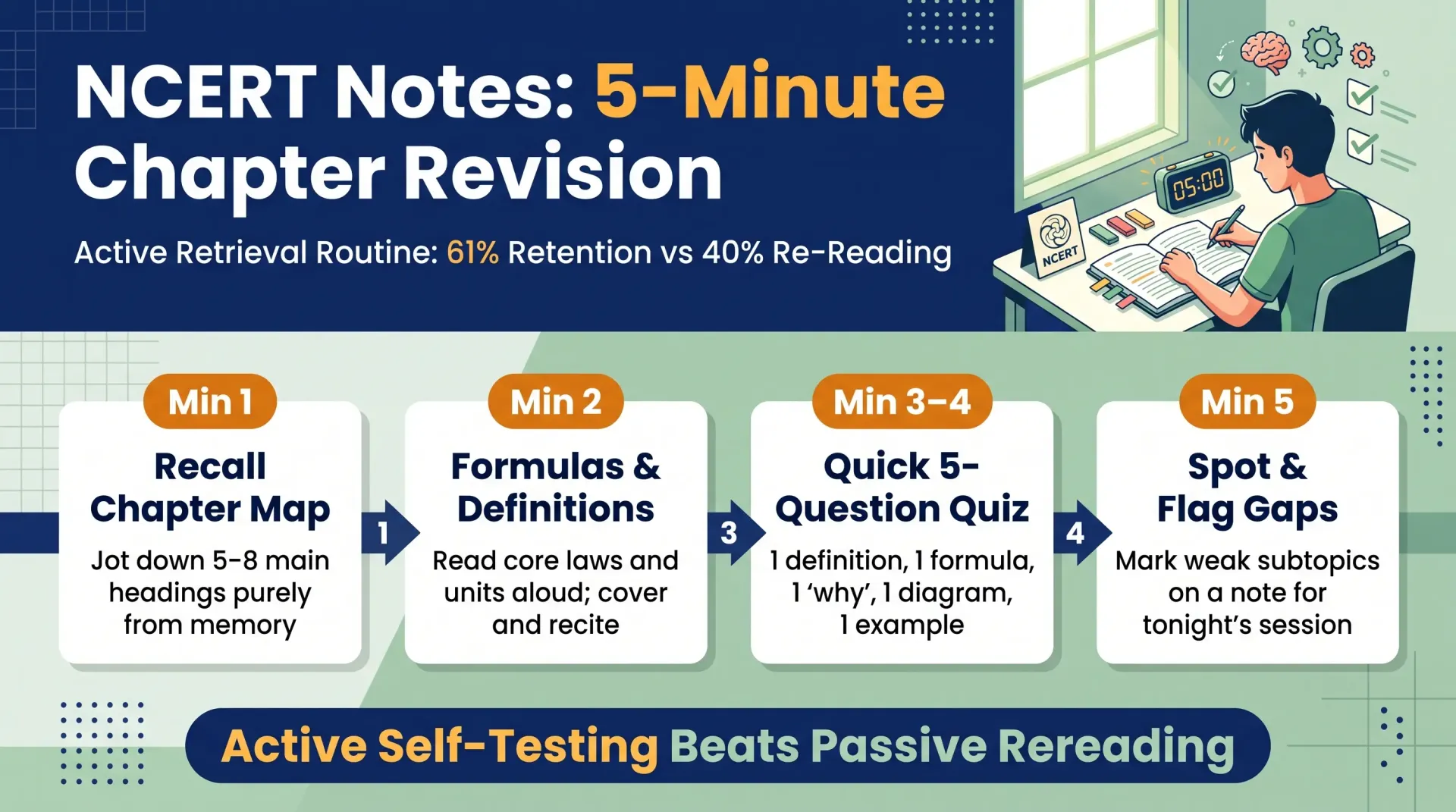
- The 4-Step Timed Routine: Spend Minute 1 recalling headings from memory, Minute 2 reciting definitions and formulas aloud, Minutes 3–4 taking a rapid 5-question quiz, and Minute 5 tagging knowledge gaps.
- Backed by Cognitive Science: Research shows practice testing yields a 61% retention rate after one week compared to just 40% for passive re-reading, making self-testing the highest-utility study method.
- Clear Boundary Conditions: A 5-minute pass serves as a pre-exam warm-up or day-before check; scoring under 50% on the self-test indicates the need for a full, comprehensive study session.
- Structured Revision with Krutsha AI: Visual notes accelerate structural scanning, interactive Skimcards provide instant self-testing, and the Revise feature automatically recycles flagged mistakes until mastery.
TL;DR· Active Recap Over Re-Reading: A 5-minute revision cannot teach a new chapter from scratch, but it effectively refreshes previously studied material. · The 4-Step Timed Routine: 1. Minute 1 (Recall): Before opening your notes, test yourself by jotting down the 5 to 8 main chapter headings from memory. 2. Minute 2 (Key Formulas & Terms): Read only the must-know definitions, formulas, and units out loud. 3. Minutes 3–4 (Quick 5-Question Quiz): Close your notes and answer 5 rapid, one-line questions without peeking (definitions, formulas, a "why" question, a diagram, and a real-life example). 4. Minute 5 (Spot Your Gaps): Mark what you missed on a sticky note so you know exactly what to practice later. · Why Testing Beats Re-Reading: Science shows that quizzing yourself helps you remember 61% of what you studied after a week, compared to just 40% if you only re-read. · How Krutsha AI Helps: Visual notes give you a fast overview, interactive Skimcards and Quizzes provide instant-reveal self-testing, and the Revise saves your mistakes so you can practice them until they stick. |
Exam tomorrow, and one chapter still feels fuzzy? Don't panic. You can't learn a whole chapter in five minutes, but with your NCERT notes you can make it feel much fresher. Here's how.
Can you really revise an NCERT chapter in 5 minutes?
Yes, but only as a recap. If you've already studied the chapter once, five minutes is enough to bring back the main ideas, key terms and formulas, and to spot what you've forgotten. If you haven't studied it yet, start with proper study notes first.
Think of it like glancing at a map before a trip. It helps, but you still have to make the trip.
How do you revise an NCERT chapter in 5 minutes?
Set a timer on your phone. Keep your NCERT notes open for the first two minutes only.
Minute 1: Recall the chapter map
Before you open anything, write the chapter's headings from memory. Most chapters have five to eight. Then check your notes. The headings you forgot show you where to look again.
Minute 2: Review definitions and formulas
Now read only the things you must remember exactly: definitions, laws, formulas, units and diagram labels. In most Class 10 notes, that's about one page. Read each formula once, then cover it and say it out loud.
Minutes 3 and 4: Test the key concepts
Close your NCERT notes and answer five quick questions, one line each. No peeking!
• One definition
• One formula application
• One "why" question
• One labelled diagram
• One real-life example
This is the most useful step. In a well-known 2006 experiment, students who practiced recalling a passage remembered 61% of it a week later, compared with 40% for students who just re-read it. Trying to remember something helps it stick for longer than reading it again.
Minute 5: Flag what needs another session
Mark every question you got wrong or felt unsure about. Write those topic names on a sticky note or in your phone. Give them a proper study session tonight or tomorrow, instead of skimming them again.
Which NCERT notes work best for a 5-minute revision?
The best study notes help you test yourself, not just read. Rereading feels useful, but it's passive. Researchers compared 10 popular study methods and rated practice testing as high-utility and rereading as low-utility. Five of the ten got a low rating. Also, check your notes against the official NCERT textbook, which is free on the NCERT website.
|
Format |
Best for |
Time needed |
|
Chapter wise notes |
Checking structure and definitions |
1-2 min |
|
Visual notes and diagrams |
Processes, cycles, labelled figures |
1 min |
|
Flashcards |
Terms, formulas, one-line facts |
2 min |
|
Skimcards or quick quiz |
Self-testing with instant feedback |
2 min |
|
List of past mistakes |
Finding weak topics fast |
1 min |
How does Krutsha make 5-minute revision easier?
Krutsha is made for exactly this routine. Its visual notes show diagrams next to the CBSE notes, so the chapter map is quick to scan. Flashcards give you deeper insights on each term. Skimcards ask quick questions, and a Reveal Answer button lets you check if you were right.
Got something wrong? The Revise section brings those questions back until you've got them right. So the topics you flag in minute five already have a place to go.
When is five minutes not enough?
Be honest with yourself. If you score less than half in your self-test, or you can't remember the chapter headings, you need a full study session. And the night before a board exam, treat five minutes per chapter as a final check after real revision.
|
|
5-minute revision |
Full study session |
|
Goal |
Refresh what you've learned |
Learn the chapter |
|
Best for |
Day-before recap, pre-exam warm-up |
New or weak chapters |
|
Uses |
NCERT notes, flashcards, self-test |
Textbook, worked examples, practice |
|
Time |
5 minutes |
Varies by chapter |
FAQs
How can I revise an NCERT chapter quickly before an exam?
Recall the chapter headings from memory, look over definitions and formulas, answer five questions without your notes, then mark what you missed. It takes about five minutes if you've studied the chapter before.
Are NCERT notes enough for CBSE Class 10 exams?
NCERT textbooks are the core of the CBSE syllabus, so notes made from them are a great base. Add practice questions and past papers to see how marks are given.
What should chapter wise notes include?
Headings, definitions, formulas with units, labelled diagrams, one example for each idea, and a short list of common mistakes. Keep it to a page or two per chapter so it's easy to scan.
Can I revise a whole subject in five minutes?
No. Five minutes covers a quick recap of one chapter. A whole subject needs a proper revision plan over several days.
Your next five minutes
Pick one chapter you've already studied, set a timer, and try this tonight with your NCERT notes. Write down what you missed. Then open Krutsha's Skimcards and the Revise section to fix those gaps. Want more tips? Read the Krutsha study blog or explore all features. You've got this!
Sources and References
|
# |
Source |
What it supports |
Link |
|
1 |
Encyclopedia.pub, "Testing Effect" |
Roediger and Karpicke's finding: 61% vs 40% recall after a week |
|
|
2 |
Vanderbilt University Center for Teaching, "Test-enhanced learning" |
Retrieving information from memory improves long-term retention |
|
|
3 |
Association for Psychological Science, "Which Study Strategies Make the Grade?" |
Dunlosky et al. (2013): practice testing rated high utility; rereading low utility, among 10 techniques |
|
|
4 |
NCERT, official textbook page |
Free NCERT textbooks for all classes |
|
|
5 |
Krutsha |
Skimcards, flashcards, visual notes and Revise features |
Glossary & key definitions
5-Minute NCERT Chapter Revision is a structured, timed active recall routine where secondary students refresh a previously studied CBSE textbook chapter in five minutes using a four-step sequence—recalling the chapter map from memory, reciting core formulas aloud, answering a rapid five-question quiz without notes, and logging exposed knowledge gaps for targeted remediation.
Sources & further reading
Test-Enhanced Learning: Taking Memory Tests Improves Long-Term Retention (Psychological Science, Roediger & Karpicke, 2006).
- Supports: Retrieval practice yields 61% recall after one week compared to 40% for repeated study.
- Link: https://encyclopedia.pub/entry/30476
Test-Enhanced Learning Teaching Guide (Vanderbilt University Center for Teaching).
- Supports: Active memory retrieval directly strengthens neural pathways and prevents rapid forgetting.
- Link: https://cft.vanderbilt.edu/
Improving Students' Learning With Effective Learning Techniques (Psychological Science in the Public Interest, Dunlosky et al., 2013).
- Supports: High-utility rating for practice testing; low-utility rating for passive rereading and highlighting.
- Link: https://www.psychologicalscience.org/
NCERT Official Textbook Repository (National Council of Educational Research and Training).
- Supports: Open-access portal hosting official digital NCERT textbooks across Classes 1 to 12.
- Link: https://ncert.nic.in/textbook.php
Krutsha AI Official Learning Platform (Krutsha AI, SSKART).
- Supports: Visual diagram notes, audio skimcards with answer reveal, 5-minute recap routines, and the Revise missed-question tracker.
- Link: https://krutsha.app/
No perspectives submitted yet. Be the first to start the discussion.