

Key takeaways
- 1 Mark = 1 Value Point: CBSE examiners grade by specific points, not essay length; write one clear textbook-based point for every mark.
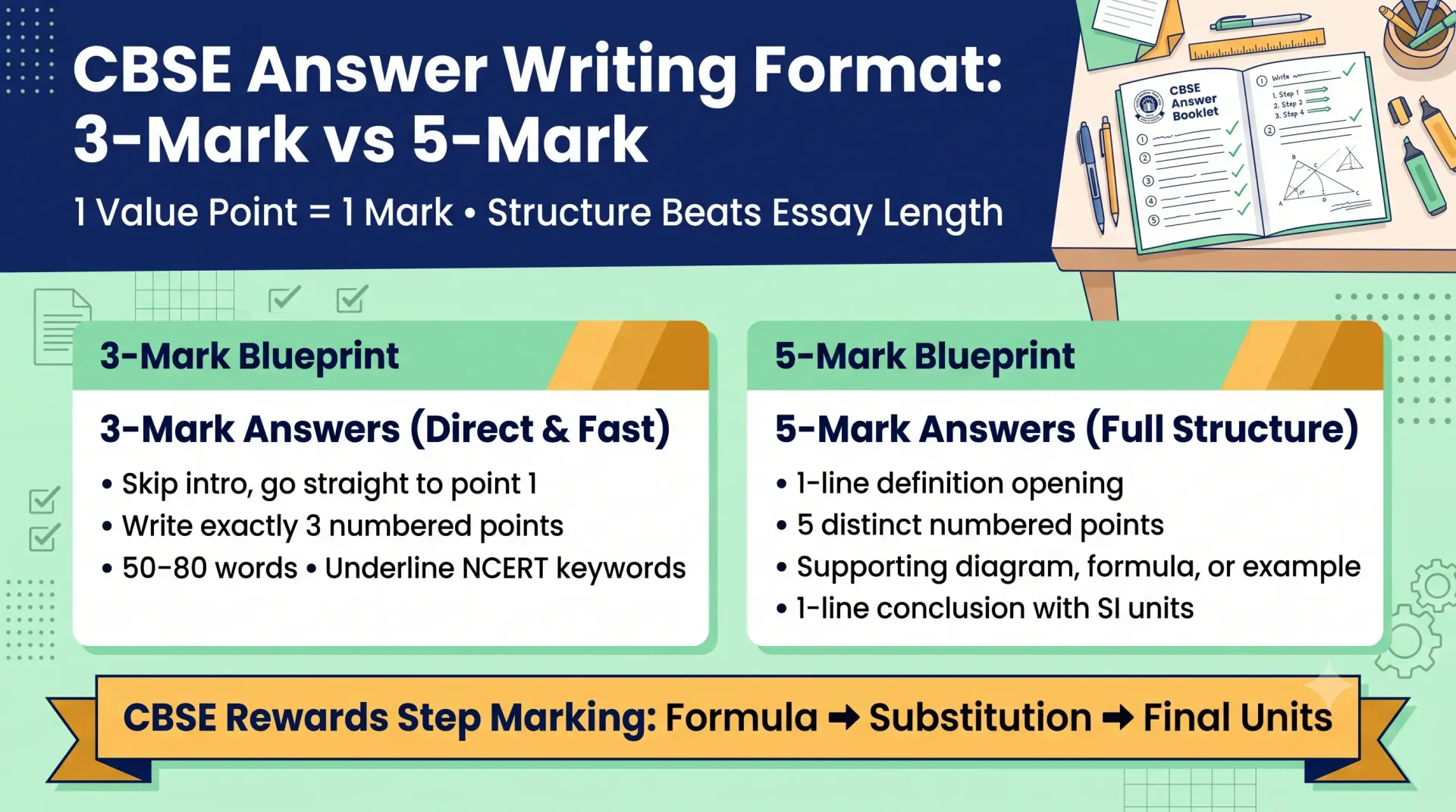
- The 3-Mark Format (Fast & Direct): Skip introductions, write exactly three clear numbered points or math steps, and stop without adding fluff.
- The 5-Mark Format (Structured Hierarchy): Open with a 1-line definition or direct answer, develop 5 distinct points, provide supporting proof (diagram, formula, or example), and close with a 1-line conclusion or final answer with units.
- NCERT Terminology & Step Marking: Underline precise textbook terms and show full step-by-step working (formula, substitution, calculations, and SI units) to capture all available partial marks.
- Active Practice Over Passive Reading: Write answers on paper first, then compare them against model answers and marking schemes using Krutsha AI to spot where your steps diverged.
TL;DR:
|
1. Mark = 1 Value Point: The examiner grades by points, not essay length. Write one clear point straight from your textbook for every mark. 2. The 3-Mark Format (Fast & Direct): o Skip the intro and go straight to the answer. o Write exactly 3 clear, numbered points (or 3 steps for math/science). o Stop there—extra lines don't get extra marks. 3. The 5-Mark Format (Step-by-Step Structure): o Start: 1-line direct answer or definition. o Body: 5 clear, numbered points. o Proof: Add 1 supporting diagram, formula, or example. o Finish: 1-line conclusion or final answer with correct units. 4. Use NCERT Keywords & Step Marking: Use textbook terms (like "transpiration" instead of "plants losing water") and underline them. Never skip math steps—formula, substitution, and units all carry separate marks. 5. Check Your Style with Krutsha AI: Write your answer first on paper, then compare it with Krutsha's direct answers and memory tips to see where you dropped marks. |
You knew the answer, yet the marks came back short. That's rarely a knowledge problem. It's a format problem, and the CBSE answer writing format fixes it. Here's how to make every line count.
What is the CBSE answer writing format?
The CBSE answer writing format is a simple pattern: one clear, textbook-based point for roughly every mark, arranged in a logical order. Marks tell you how much to write. The marking scheme tells you what earns those marks, and it varies by subject and by question. Treat this guide as a framework, not a rulebook.
How do CBSE marking schemes decide your marks?
CBSE publishes marking schemes alongside its sample question papers on cbseacademic.nic.in. For 2025-26, an official notification dated 30 July 2025 confirmed that the assessment scheme stayed unchanged for Classes X and XII. The Class 10 paper runs 3 hours with no negative marking, so a partly right answer is always worth attempting.
Maths is marked step by step. As this breakdown of the Class 10 scheme explains, correct method can earn credit even when the final number slips. Theory subjects often split marks across distinct points. Before you practise, open your subject's marking scheme and see how three or five marks are divided. That split is your template.
How do you write a 3-mark answer in CBSE exams?
Write three short, clear points (or three steps if it’s a numerical), then stop. A 3-mark answer rewards precision, not length.
1. Circle the command word. Define, state, differentiate, explain and calculate each ask for something different.
2. Plan three points first. Jot them in the margin.
3. Use textbook terms. Use the words your NCERT book uses.
4. Stop at point three. Extra lines rarely add marks.
Illustrative layout (Class 10 Maths): find the sum of the first 20 terms of the AP 5, 8, 11, … Write the given values (a = 5, d = 3, n = 20) and the formula Sₙ = n/2 [2a + (n − 1)d]. Substitute: S₂₀ = 10 [10 + 57]. Finish: 10 × 67 = 670. The official split of marks may differ, so check the scheme. For numericals, explore our NCERT numerical solutions guide.
How do I write a perfect 5-mark answer in CBSE exams?
Open with a one-line definition or direct answer, develop five distinct points in logical order, support at least one with an example, labelled diagram or working, and close with a one-line conclusion.
1. Open sharply. One line that answers the question or defines the key term.
2. Give five separate points. One per numbered line.
3. Add proof. An example, a neat labelled diagram or a worked calculation, where the subject allows it.
4. Close in one line. A conclusion or final answer, with its unit if it's a numerical.
3-mark vs 5-mark at a glance
|
Feature |
3-mark answer |
5-mark answer |
|
Points to cover |
About 3 |
About 5 |
|
Opening |
Go straight to point one |
One-line definition or direct answer |
|
Working or diagram |
Include if asked |
Include at least one supporting element |
|
Rough length (guide only) |
50-80 words |
100-150 words |
|
Closing |
Not needed |
One-line conclusion or final answer |
How do you use textbook terminology and organise points?
Use the exact words from your NCERT book. Write "transpiration," not "plants losing water." Underline key terms and give every point its own line. If you're revising science lab concepts, see our CBSE science practical file guide to learn how examiner value points work in experiment write-ups.
How much working should you show?
Show given data, formula, substitution, calculation, and the final answer with its unit. In Maths and Physics, working often carries the marks. The Formulas section in Krutsha lays out each formula, its steps, units and common mistakes, so you can copy the habit. Supplementary formula sheets are also available in our free study resources vault.
What mistakes cost students marks?
• Writing a 5-mark essay for a 2-mark question.
• Ignoring the command word and explaining when asked to state.
• Skipping working because the answer "was obvious."
• Forgetting units on numerical answers.
If you ever get stuck working through a complex step at night, you can use 24x7 AI doubt solving to see the intermediate line-by-line working.
How can you practise marks-matched answers?
In Krutsha's Question & Answer section, each question carries an easy, moderate or hard label, key points, a direct answer showing how to write it in the exam, and a memory trick. Write your own answer first, then compare. Get it on Google Play.
FAQs on the CBSE answer writing format
How many points should a 5-mark answer have?
Aim for about five distinct, relevant points, one per mark, unless the question or marking scheme splits marks differently. Add an example only if it earns its place.
How long should a 3-mark answer be?
Around 50-80 words is a handy rule of thumb for theory subjects. It isn't an official CBSE limit. Cover three points clearly.
Do CBSE marking schemes differ by subject?
Yes. Maths awards marks step by step, theory subjects often award marks per correct point, and individual questions may split marks differently. Check your subject's scheme on cbseacademic.nic.in.
Where do I find official CBSE marking schemes?
On the CBSE Academic website, in the Sample Question Papers section for Class X or XII. Each sample paper comes with its marking scheme.
Should I draw diagrams in a 5-mark answer?
Only where the question or subject calls for one, such as labelled diagrams in Science. A neat diagram supports your points. It doesn't replace them.
Your next step
Marks follow structure. Pick one chapter today, write one 3-mark and one 5-mark answer, then compare them with a model answer in Krutsha.
Which resources help with CBSE answer writing?
|
Resource |
What you'll find |
Source type |
|
Official sample papers with marking schemes for 2025-26 |
Official (CBSE) |
|
|
Class 12 sample papers with marking schemes for 2025-26 |
Official (CBSE) |
|
|
Confirms the assessment scheme is unchanged for 2025-26 |
Official (CBSE) |
|
|
Exam duration, no negative marking, step marking in Maths |
Third-party |
|
|
Notes, formulas, Q&A with direct answers, practice quizzes |
Krutsha |
|
|
Android app for studying and practice on the go |
Krutsha |
Glossary & key definitions
CBSE Answer Writing Format is a standardized exam presentation structure where secondary and senior secondary students allocate approximately one textbook-based value point per mark—using command words, NCERT keywords, stage-wise mathematical derivations, and supporting diagrams—to maximize marks under official board evaluation rubrics.
Sources & further reading
CBSE Class X Sample Question Papers and Marking Schemes 2025-26 (CBSE Academic).
- Supports: Official Class 10 question designs, value-point allocations, and step-marking templates.
- Link: https://cbseacademic.nic.in/
CBSE Class XII Sample Question Papers and Marking Schemes 2025-26 (CBSE Academic).
- Supports: Senior secondary marking criteria and point distribution rubrics.
- Link: https://cbseacademic.nic.in/
CBSE Official Notification regarding Assessment Scheme (30 July 2025).
- Supports: Formal board confirmation that the core assessment framework remains unchanged for 2025-26.
- Link: https://cbseacademic.nic.in/
Class 10 CBSE Marking Scheme Overview.
- Supports: 3-hour examination duration, absence of negative marking, and stage-wise calculation credit.
- Link: https://cbseacademic.nic.in/
Krutsha AI Official Learning Platform (Krutsha AI, SSKART).
- Supports: Direct exam-style Q&A models, step-by-step formula breakdowns, AskAI doubt solving, and Link Parent updates.
- Link: https://krutsha.app/
Krutsha AI-NCERT Learning App (Google Play Store, updated Sep 2026).
- Supports: Mobile platform availability, Class 8–12 NCERT curriculum alignment, and diagnostic practice tools.
- Link: https://play.google.com/store/apps/details?id=com.sskart.krutsha
No perspectives submitted yet. Be the first to start the discussion.